

The third heat wave of the summer is officially over, but firefighters’ garden fire safety tips still matter. After nearly 3,000 hectares burned in the Hautes Fagnes, crews remain on high alert. Temperatures may have fallen, but the ground is still often very dry in places.
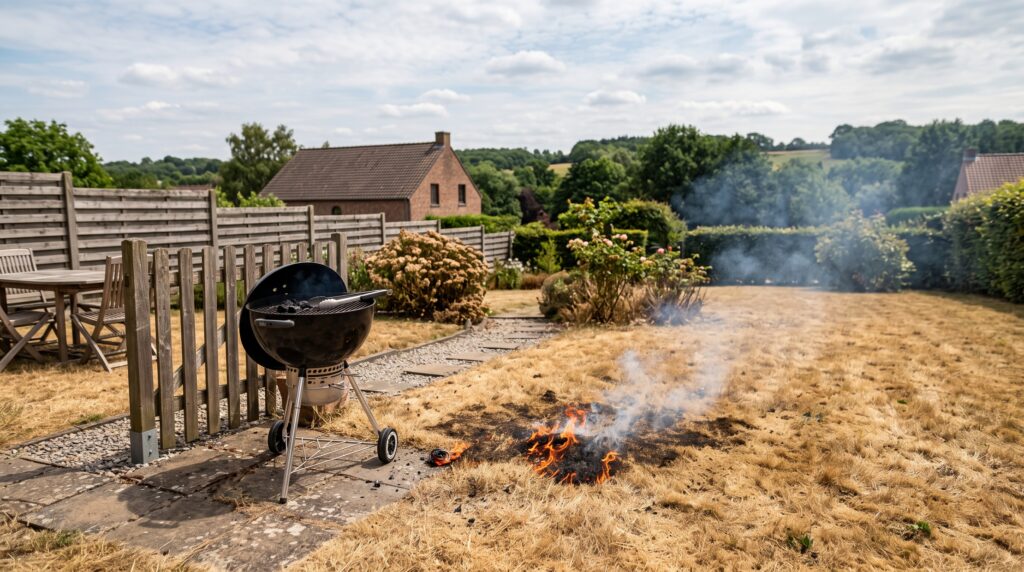
Belgium has experienced three heat waves this year, and vegetation fires have multiplied: more than 80 had been recorded by late July, even before the fire in the Hautes Fagnes on August 14. The ground and vegetation have endured weeks of drought. It takes far more than a few showers to restore their moisture. In other words, your yellow lawn is still excellent fuel for a fire.
Garden fire safety tips: 5 habits to avoid
Using a flame weeder
Since chemical weedkillers have been largely banned, flame weeders have grown in popularity. Yet these tools can be extremely dangerous on dry ground. A moment’s distraction or a flame held too close to a blade of grass can set the whole garden alight, and potentially more. Several provincial police orders have even banned their use outright during high-risk periods.
Keeping gasoline in a plastic can
Few plastic gasoline cans are completely airtight and release no vapor. If a can is kept inside a car’s passenger compartment or in an overheated, closed room, the slightest spark, from lighting a cigarette, for example, can cause everything to catch fire.
Leaving plastic or glass bottles around
A water bottle may seem harmless, but its magnifying-glass effect can be dangerous, whether it is plastic or glass. If a flammable object or a very dry patch lies in the path of the focused sunlight, a fire is almost inevitable.
Running farm machinery and lawn mowers
Farmers know this risk well: fire spreads incredibly quickly through such dry grass. Take care with machinery running at full power, as a small mechanical spark can set an entire field alight. The same warning applies to lawn mowers, though to a lesser extent. The same principle applies to your car: avoid parking in tall grass, as the exhaust pipe alone can start a fire.
Using a barbecue
The risk is obvious, yet widely underestimated. Barbecues are one of the main causes of fires. To stop a relaxing moment from turning into a disaster, handle your barbecue carefully and never place it on an unstable surface or near flammable materials. Avoid nylon or other synthetic clothing, and keep a blanket, a fire extinguisher or a garden hose within reach. Several provincial orders have banned charcoal and wood-fired barbecues on public land.
If a fire starts, call 112 immediately
Even if you think you have the situation under control, act early. Firefighters stress that the vast majority of fires in natural areas result from human negligence, and a fire you believe is out can still flare up again.
The response is simple: call 112 and give your location as precisely as possible. Then leave the area using existing paths and warn people nearby.
 Open Immovlan