

The balanced interiors you admire in magazines can feel hard to recreate. Even carefully chosen accessories may not look quite as you hoped once you bring them home. Among the interior decorating tips professionals use, one simple technique stands out: the rule of three. It is easy to understand and apply, and particularly effective at giving your decor a sense of structure.
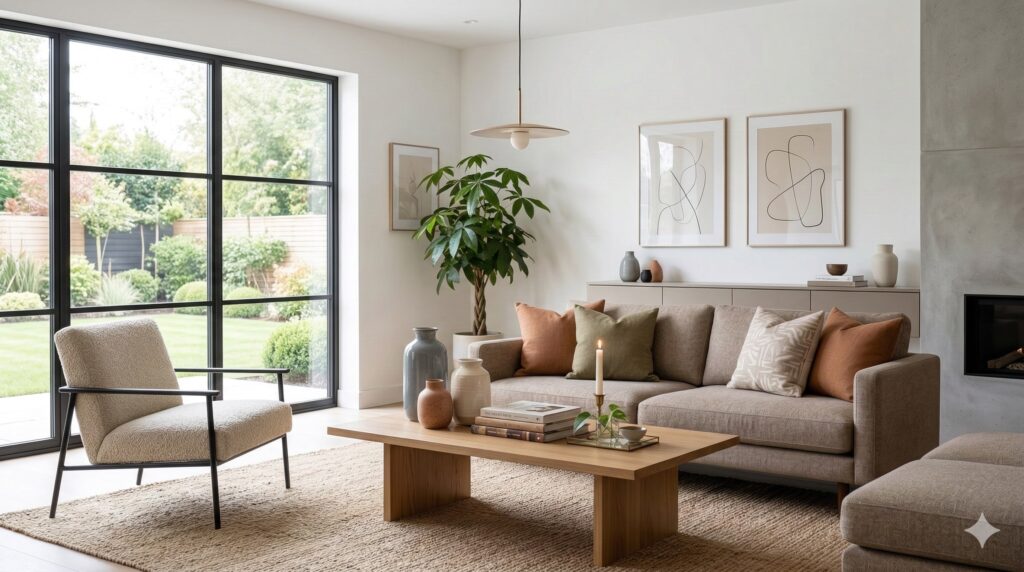
Interior decorating tips: the rule of three
You may love your decorative objects individually but find that they look disorganized or out of balance when you bring them together. The rule of three can transform the way you decorate. The principle is simple: group items in threes to create a more natural visual balance.
This technique works with many accessories: candleholders, vases, picture frames, plants, throw pillows or decorative objects. Arranging them in groups of three generally creates a more dynamic, attractive display. This approach is widely used in interior design because it creates a focal point without looking too rigid.
Once you know this rule, you will probably start noticing it everywhere, from decorating magazines and furniture showrooms to professional interior photographs.
However, avoid applying the rule too strictly. You do not need to arrange absolutely everything in groups of three. The idea is to use odd numbers to create a more natural composition. Several studies of visual perception show that our brains remember odd-numbered groups more easily and that, starting with three items, we instinctively begin to see a pattern or a small collection.
Start with your coffee table
The living room coffee table is often an ideal place to try this technique. It is a prominent spot, but easy to rearrange if you want to adjust the decor.
For example, you could arrange three decorative objects:
- three vases of different sizes,
- three candleholders,
- or a mix such as a vase, a small plant and a decorative book.
For a more natural look, avoid placing the objects right in the center of the table. Shift your arrangement slightly to one side for a more relaxed, modern look, an approach professional decorators often use.
You can also play with heights and textures. For example, combine a tall object with a medium-height one and a shorter one. This variation creates more visual depth.
The rule of three for colors
The rule of three is not just for objects. It also works very well with colors in your home.
Try combining three main colors in a room. For example:
- a dominant color, often a neutral such as white, beige or gray,
- a secondary color to add character,
- and a third, accent color to bring the scheme to life.
Against a neutral backdrop such as a white wall, three well-chosen colors can create a harmonious, balanced feel. Just choose shades that work well together so the result does not look too busy.
Use multiples of three
The good news is that you do not have to limit yourself to exactly three items. Multiples of three also work very well.
For example:
- 6 or 9 picture frames arranged on a wall,
- 6 throw pillows on a sofa,
- or an arrangement of 9 decorative objects on a large shelf.
This approach is particularly useful when you create a wall of framed pictures or a gallery wall. Multiples of three give the display structure while keeping it visually pleasing.
 Open Immovlan