

After competing on capacity, energy use and noise levels, appliance manufacturers are now battling over artificial intelligence. An AI dishwasher no longer just sprays hot water: it analyzes the load, weighs it and adjusts its cycle in real time.
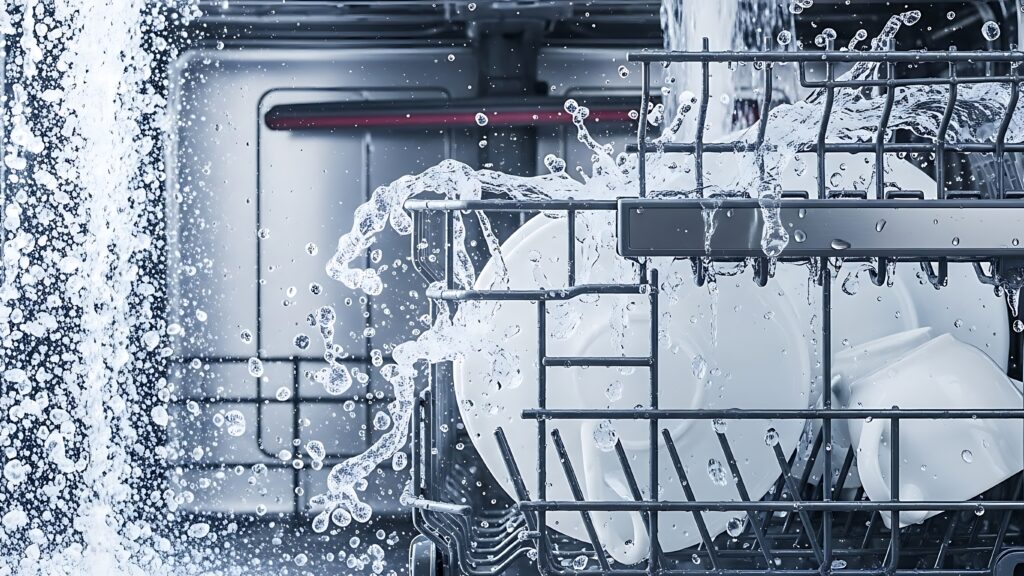
For you, the difference is less time spent choosing a program. Unlike a cooking robot, a dishwasher’s AI doesn’t prepare anything: its main job is to use resources efficiently and deliver spotless results without you having to think about the settings.
How an AI dishwasher adjusts its wash cycle
This is its most practical use. Conventional dishwashers often offer dozens of programs (Eco, Intensive, Glass…), yet we tend to use the same one out of habit. With the wrong settings, you risk wasting water on three plates or finding that your dishes are still greasy.
AI acts like a meticulous butler. Using turbidity sensors, which measure how dirty the water is, along with weight sensors, it automatically adjusts the cycle length, temperature and water use to suit the amount of dishes and how dirty they are. Rather than simply following a preset routine, it recalculates the duration, temperature and spray pressure midway through the cycle. It won’t turn a dish covered in burnt-on food into sparkling crystal, but it should provide consistently clean results without waste.
Resource use that adapts to your needs
The other main benefit is energy efficiency. Some smart models analyze your habits and electricity rates.
- They automatically favor off-peak hours.
- Models with automatic dosing dispense the precise amount of detergent needed, avoiding excess chemicals.
- They take water hardness into account to protect your glasses from limescale.
Of course, everything depends on the quality of the sensors, and this is no miracle solution. Your bills might fall, but the savings will probably be too small to notice.
Sound and connectivity: useful features or gimmicks?
It’s the paradox of modern appliances: they connect to our Wi-Fi, but the reason isn’t always obvious. In practice, smart features have a useful maintenance role. AI can analyze the condition of the spray nozzles or filters and send you a notification before a breakdown occurs.
Some modes also let you download new, specialized cycles through an app, such as ones for plastic lunch boxes or baby bottles. Still, we can agree that a good sponge will do a better job on stains that have been stuck there for three days.
The downside of too much automation
Not everything works perfectly. Sometimes AI tries too hard: in its efforts to optimize everything for the environment, it can make certain cycles extremely long, sometimes more than 4 hours. That can be frustrating when you’re in a hurry.
Advanced electronics are also more prone to failure than the old mechanical buttons our grandmothers used. And all that complexity can put off purists who mainly want something simple. Fortunately, most manufacturers let you take back control and run a conventional manual mode.
How much more does it cost?
You don’t necessarily need to spend a fortune, but this technology comes with an upfront cost. Dishwashers with decent AI features are currently available for around €500 to €700. Premium models that are ultraquiet and fully automated can cost more than €1,200. The price depends more on the quality of the materials and fittings, such as a stainless steel tub and adjustable racks, than on the AI itself.
Is it worth buying?
A good dishwasher still depends first and foremost on effective spray arms and efficient drying. Smart features can help, though: they compensate for dosing mistakes and spare you the hassle of adjusting settings manually.
 Open Immovlan