

Wood pellet storage safety may seem straightforward. Pellets are clean and practical, and easy to put away. You might worry about moisture or dust, perhaps even clutter in the garage. A deadly hazard is less likely to come to mind. Yet the danger is real.
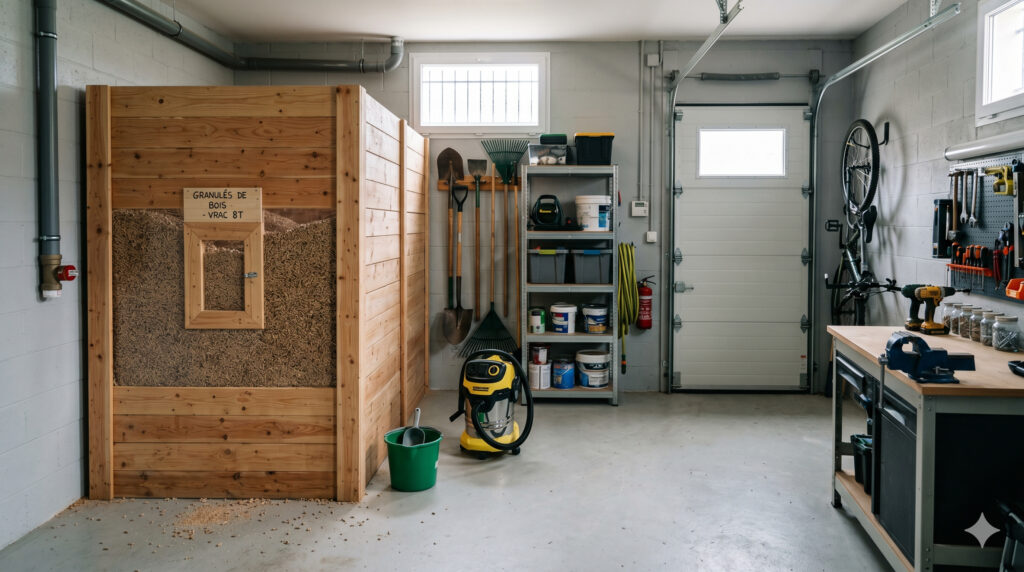
The Belgian Poison Centre (Centre Antipoisons) warns that wood pellets stored in an enclosed space can release carbon monoxide without burning, simply through the natural oxidation of compounds in the wood. The immediate threat is not fire but an invisible, odorless and highly toxic gas. Anses, France’s national health safety agency, brought the issue back into focus in a bulletin published on April 15, 2026, showing how widely this problem is still underestimated.
This risk is not just theoretical. Britain’s Health and Safety Executive (HSE) had already reported at least nine deaths in Europe following entry into pellet storage areas. The real trap is that carbon monoxide (CO) can take effect in two minutes, just enough time to step into the storage area and pick up a small item.
Why do wood pellets release CO?
The process involves natural auto-oxidation: pellets continue to react chemically while in storage. According to safety guidance, emissions depend on temperature as well as the type of wood and the age of the pellets. They release more gas during the first few weeks after manufacturing. In an enclosed storage area, a silo or a poorly ventilated room, this CO can accumulate and oxygen levels can fall.
When is pellet storage most dangerous?
In practice, the danger becomes particularly serious with bulk storage or large quantities (several tons), and in poorly ventilated spaces. The fact that pellets are “natural” changes nothing: natural does not mean harmless. Authorities focus particularly on enclosed rooms, tanks and silos, where gas can build up unnoticed.
The symptoms of carbon monoxide poisoning often begin deceptively: headaches, dizziness, nausea and fatigue. You might mistake them for overheating, lingering flu or simply a particularly difficult day. Yet the Poison Centre warns that as the concentration rises, you can lose consciousness very quickly, with a real risk to your life.
Wood pellet storage safety precautions
The first precaution is simple: never enter an enclosed pellet storage area without appropriate safety measures. Britain’s HSE explicitly recommends not entering the storage area, or even putting your head into a hopper, unless a controlled procedure is followed, the area has been ventilated beforehand and the air has been checked. BeSWIC, the Belgian Knowledge Centre on Well-being at Work (Centre de connaissance belge sur le bien-être au travail), also stresses professional installation and safety information, as well as the need to treat these spaces as potentially toxic. At home, this means planning a dry, well-designed storage area that is separate from living spaces and has effective ventilation.
 Open Immovlan