

A balcony solar battery is a small home battery, often plug-and-play, designed to work with one or two balcony solar panels. The idea is simple: your panels generate electricity during the day, the battery stores the surplus, and you use it in the evening to power small appliances…
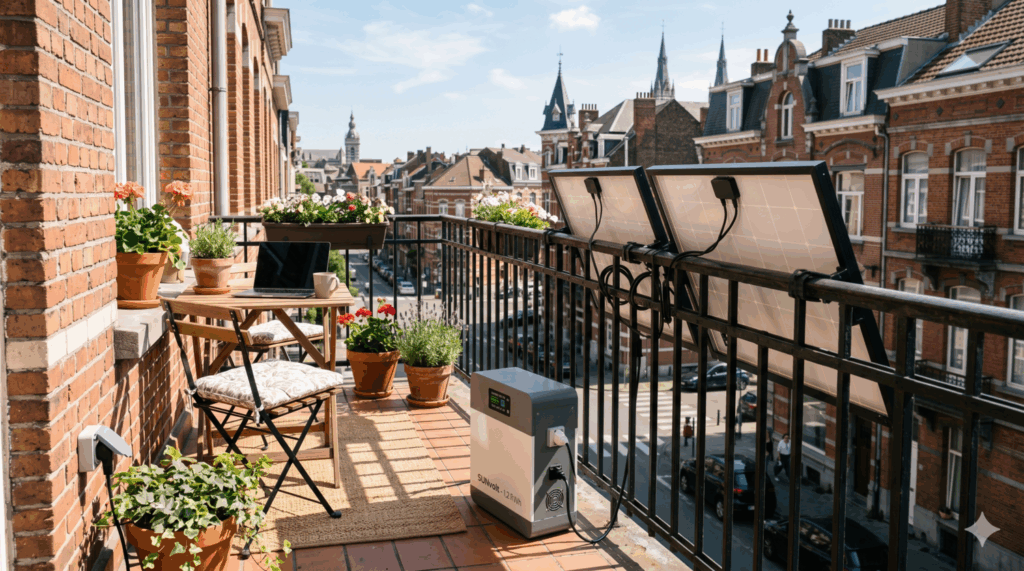
To use it this way, you need solar panels, usually plug-and-play models if you live in an apartment with a balcony. The battery itself does not generate any electricity. Without solar panels, it may let you shift when you draw electricity from the grid under certain contracts, but its main purpose remains solar self-consumption: using the electricity you generate yourself. The aim is to avoid feeding some of your production into the grid for little or no payment.
Is a balcony solar battery legal in Belgium?
Since April 2025, approved plug-and-play solar panels and batteries can be used in Belgium, provided they fall within the framework set by Synergrid. In Wallonia, small plug-and-play solar modules rated below 1 kW can be connected to an outlet, but they must be declared to the grid operator using form UP10.
What does it actually do?
Its main role is to increase your self-consumption. Without a battery, electricity generated at midday mainly powers appliances running at that time: the refrigerator, internet router or a dishwasher timed to run then. With a battery, some of that energy can be saved for the evening. This is useful for apartment residents, renters or anyone without access to an entire roof.
It can also smooth out your electricity use and reduce what you draw from the grid during certain hours. But don’t expect superpowers: a small balcony battery will not run an entire home all night. It is better suited to background electricity needs, such as lighting, a computer, television, router and small appliances. Running the heat pump, induction cooktop or tumble dryer on full power is another matter.
How much does a balcony solar unit cost?
When budgeting, separate the cost of the panels from that of the battery. Base prices for panels range from a few hundred euros to more than €1,000, depending on the output you want. Plug-and-play batteries generally cost between €1,000 and €2,000, depending on capacity, with a cost per kWh often between €400 and €700.
In other words, a small balcony system with one or two panels, a battery, cables and mounting brackets can easily cost between €1,500 and €3,000. Secure mounting matters too: a balcony panel needs to withstand wind and rain without crashing down on the unsuspecting neighbor below!
What return can you expect?
Let’s be honest: you will probably have to wait a very long time to recover your investment, especially as there is no longer a specific direct grant for a home battery in Wallonia, Brussels or Flanders in 2026. A reduced VAT rate of 6% may apply in some cases, notably when a professional carries out the installation in a home more than 10 years old.
In Brussels, conventional photovoltaic panels can still benefit from the green certificates (certificats verts) scheme. However, plug-and-play panels connected directly to an outlet do not qualify, according to Sibelga and BRUGEL.
Verdict: a good idea or just a gadget?
A balcony battery makes sense if your balcony faces the right direction, you regularly use electricity in the evening and, above all, you want to generate some of your own electricity without major building work. It also gives you a way to protect yourself a little more against sudden energy price increases, which are certainly not an unlikely prospect. It is less convincing if your balcony is shaded, you use most of your electricity during the day or you want a quick return on your investment. No, it is certainly not a miracle solution.
 Open Immovlan