

According to a recent report from the International Energy Agency (IEA 4E EDNA), plug in home battery storage could make storing electricity accessible to far more households. Renters could benefit too.
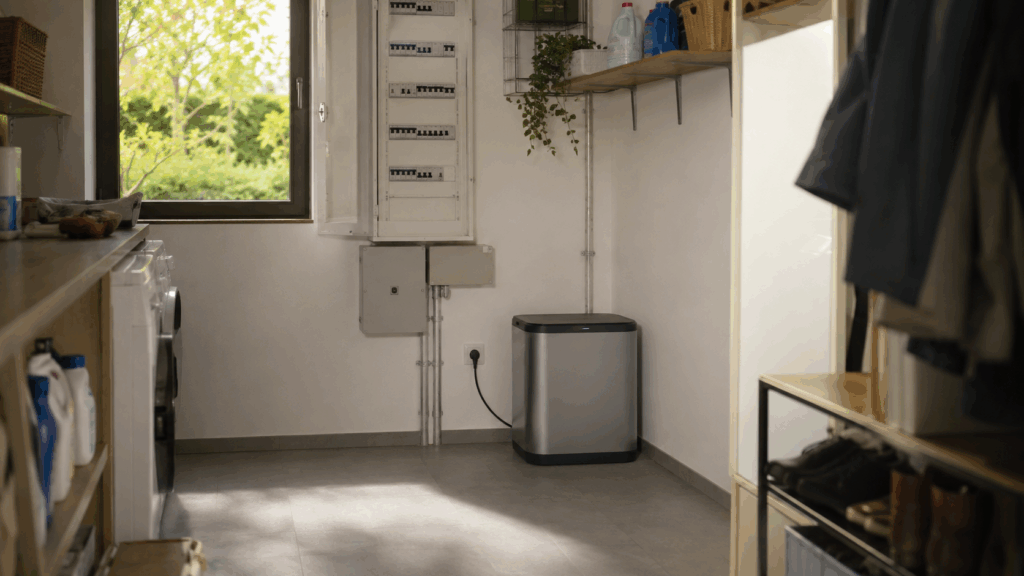
Installing a home battery without building work or complex wiring, and sometimes without an electrician, seemed unlikely not so long ago. Yet plug-in batteries, also known as plug-in BESS, are starting to gain a foothold in Europe’s energy market.
The principle is straightforward: these compact systems, usually paired with balcony solar panels, store electricity generated during the day and then feed it back into the home. Their capacity remains modest, often below 3 kWh per unit, but several modules can be stacked to increase storage.
Plug in home battery storage opens up solar access
One of the main attractions of these systems is their accessibility. Until now, renters, apartment residents and households without a suitable roof were largely excluded from the home energy storage market. With a battery that recharges through an outlet and a few panels installed on a balcony, they can generate some of their own electricity, store it and use it when electricity rates rise or the sun goes down.
This ease of installation could also reduce pressure on specialist installers, who are already in high demand. However, the report stresses that some homes, particularly those with older electrical systems, may need a professional inspection before anything is plugged in. Just because the label says “plug and play” doesn’t mean you can “plug it in with your eyes closed”!
Germany is already ahead
Germany is the real-world testing ground for this new trend. The number of registered balcony solar systems there rose from fewer than 100,000 in 2022 to more than a million by mid-2025. The country is also estimated to have had around 113,700 plug-in batteries with a capacity below 2 kWh installed by the end of 2025. Several factors are driving this growth: high electricity prices, an established DIY culture, substantially simpler administrative procedures and reforms making installation easier for renters, who are particularly numerous in neighboring Germany.
Since 2024, German property owners and landlords have no longer been able to block the installation of small solar systems without a valid reason. Registration has also been simplified.
Performance is still difficult to compare
Despite their potential, these batteries suffer from a lack of transparency. Among the products studied in the report, only two manufacturers disclosed their round-trip efficiency, meaning the share of energy actually recovered after storage.
The advertised lifespan often reaches 6,000 cycles, with warranties ranging from 10 to 15 years. Yet testing methods are rarely explained in detail. Entry-level prices generally range from €1,000 to €2,000, while stacked systems can cost more than €4,000.
Safety remains the main concern
Most systems limit their electricity output to 800 watts by default, a threshold widely used in Europe. They also include protection against overheating, short circuits and power surges.
But rules vary considerably between countries. Belgium has already created a specific framework for plug-in batteries, while Germany is still developing its standards. The report recommends clearer requirements, particularly for performance, installation locations, fire protection and recycling.
Financial returns depend on the right conditions
As we discussed recently, this is not a miracle solution for everyone. The conditions really do need to line up for the investment to pay off, and any return will necessarily come over the long term. You need a sunny balcony and electricity use that falls at a different time from generation.
 Open Immovlan