

Thermal energy storage in… sand, to heat a neighborhood: the idea sounds unusual, but it is already working in Finland.
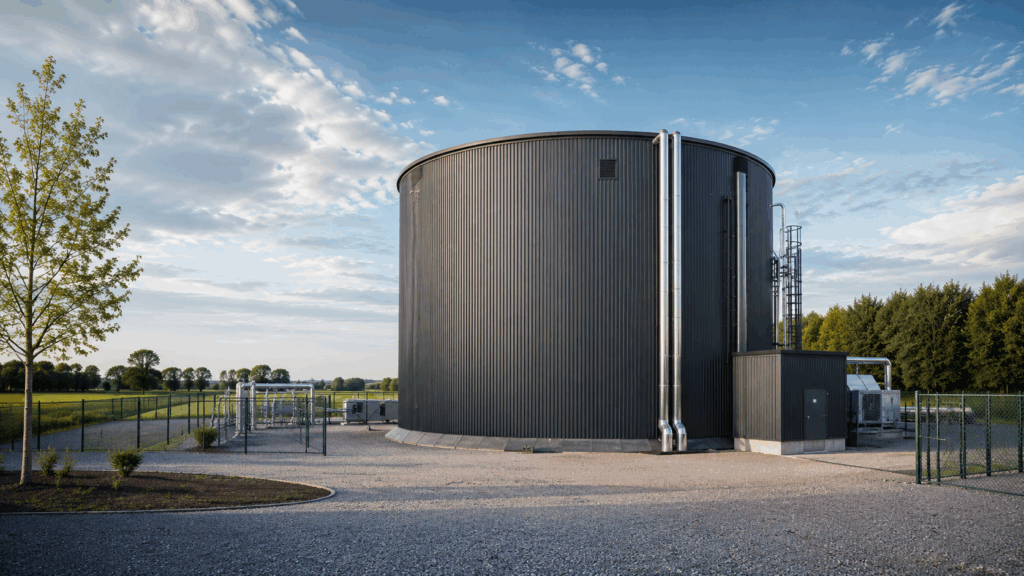
When we think of energy storage, we usually picture a lithium-ion battery paired with solar panels. In Finland, a different approach is reaching new heights, quite literally: the new “sand battery” installed in Pornainen is about 13 meters tall and 15 meters wide.
Inside, there is no lithium, cobalt or miniaturized electronics. The tank holds around 2,000 metric tons of crushed soapstone, a material sourced from stove manufacturing waste. The installation can store up to 100 MWh of thermal energy and deliver 1 MW of heating power. It has been supplying this small Finnish municipality’s district heating network since 2025.
The word “battery” needs a little explanation here. The system does not store electricity directly: it converts available electricity into heat, stores that heat in the mineral material, then releases it when a building needs it.
How thermal energy storage works in a sand battery
When renewable electricity production is plentiful or prices are low, electric resistance heaters warm the air. This air circulates through the tank, heating the material to several hundred degrees.
Thick insulation allows this heat to be stored for days, or even longer. When needed, the system recovers the hot air and uses it to heat water for the local district heating network.
Think of it as preparing an enormous hot-water bottle while the sun shines, ready to use on a January evening!
Heating remains one of the largest sources of energy consumption in buildings. A shared thermal battery could supply apartments, offices, schools or sports centers connected to the same network. District heating networks already exist, of course. But this technology could also absorb surplus energy produced by solar panels, wind turbines or large heat pumps.
A major advantage of this technology is its use of abundant, inexpensive materials. The soapstone used in Pornainen is even an industrial by-product. The system also uses fewer critical materials and could operate for several decades.
A promising solution, but not a miracle
The sand battery has limitations too: it mainly delivers heat. Converting that heat back into electricity would involve significant losses. It therefore cannot replace a home battery or the electricity grid, and it is no substitute for good insulation.
 Open Immovlan