

You’ve probably heard plenty about walk-in showers, which have been popular for many years. Here’s a closer look at walk-in shower pros and cons before you commit.
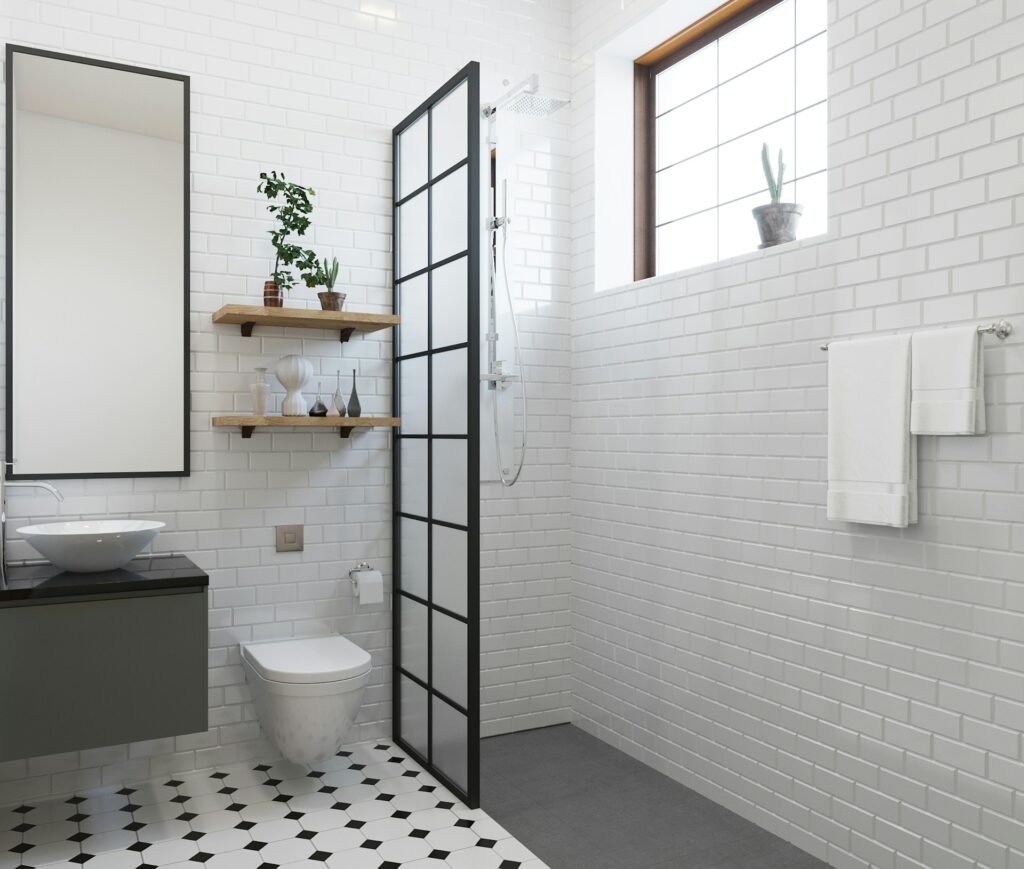
Walk-in showers are gradually replacing traditional shower enclosures, particularly because they are easier to access, more pleasant to use and often more attractive. They suit almost any bathroom style, from traditional to contemporary. Installation does take careful preparation, though, and it’s worth understanding their limitations before you start.
Walk-in shower pros and cons: understanding the design
In a true level-access shower, the shower floor sits at the same height as the bathroom floor. Unlike a traditional shower, there is generally no step or substantial lip to cross.
The floor slopes slightly so that water flows naturally toward a linear shower drain or a standard drain. This slope is often almost invisible, but it plays an essential role in making the shower work properly.
There are also models with an ultra-low-profile shower tray. These give a very similar result while sometimes making installation easier, especially during a renovation. In fact, that’s the option I chose for my own renovation.
The advantages of a walk-in shower
One of the main benefits is accessibility. Without a high threshold, the shower is easier to use for children, older people and people with reduced mobility. It also makes moving around the bathroom easier.
A walk-in shower gives you plenty of freedom over dimensions. It can fit into a narrow space or a corner, or run along the full width of a wall. That means you can adapt it to the layout of almost any bathroom.
There is also a wide choice of finishes. Options include tile, natural stone, polished concrete, a resin tray or a slip-resistant covering. You can also customize the shower screens, faucets and accessories.
With its simple lines and fewer corners or ledges, a walk-in shower is generally easy to clean.
Its open design also creates a sense of lightness and space, which is especially noticeable in a small bathroom.
Should you choose a shower tray?
You can choose a walk-in shower with or without a tray.
Without a tray, the bathroom floor continues directly into the shower area. This is more complicated to install, but the finished result usually looks very good.
You do need enough space beneath the floor to fit the drainage system, create the right slope and make everything fully watertight. During a renovation, this may mean altering the floor structure or raising the shower area slightly. All of that affects the budget, especially if you hire someone to do the work.
A shower with an ultra-low-profile tray is often quicker and simpler to install. Trays come in many materials, colors, shapes and sizes. Some can even be cut to fit the available space precisely. Another useful point, and one I know from experience: if there is a wastewater drainage problem, this type of tray is easier to remove and refit than taking up an entire tiled surface.
Do you need a shower screen?
Completely open walk-in showers are fairly common. They reinforce that feeling of freedom and give the bathroom a very clean-lined look. However, a shower without a screen can cause more splashing. You need to consider the shower’s length, the showerhead’s position and the strength of the spray. Frankly, we know quite a few friends who have gone off the idea. It looks good, but living with it can be a nuisance.
A glass screen is often an excellent compromise. It catches much of the spray without visually closing off the space. In a small bathroom, clear glass lets light through and helps create a greater sense of depth. To make maintenance easier, you can choose glass with an anti-limescale treatment. Regular cleaning with a squeegee will then help keep the screen clean.
Getting the slope and drainage right
Water must drain quickly without forming puddles. To achieve this, the shower floor needs a sufficient slope toward the drain. That slope must be even and run in the right direction. If it is too shallow, water may collect. If it is too steep, the floor can become less comfortable to stand on and harder to tile.
The choice of linear or standard drain also matters. It must be able to handle the flow from the showerhead, particularly if you use a large rainfall showerhead. And don’t forget: drainage pipes need a slope of 1 centimeter per meter, or 1%.
It is also worth providing easy access to the trap so you can clean it and remove the hair or residue that will inevitably slow the flow.
Waterproofing deserves close attention
Waterproofing is probably one of the most important aspects of a walk-in shower. Tile grout alone cannot completely stop water from penetrating the floor or walls.
A waterproof layer must be installed beneath the finish, particularly in corners, around the drain and at the joints between the floor and walls. If you use drywall, our advice is to choose boards designed for this purpose and give them a generous coating of a water-repellent product. Admittedly, it’s far from cheap.
A leak can remain invisible for some time before causing damp patches, mold, loose tiles or damage in neighboring rooms.
Think about safety too
The shower floor is regularly wet, so it is best to choose a slip-resistant surface, especially if children or older people will use it. You could also include a grab bar, a wall-mounted seat or a built-in storage niche. These features improve comfort without necessarily making the design look bulky, although they can complicate installation.
Remember ventilation as well, though that applies to every bathroom.
Hire a professional
Installing a walk-in shower yourself is possible. I can vouch for that, having done it with plenty of help from people close to me after being let down by a supposed professional. Still, you need solid DIY skills. Don’t rely solely on a few tips from friends or AI. Have professionals available for essential stages such as tiling, waterproofing and drainage.
I would take the same approach again, but I strongly recommend hiring a qualified professional who comes highly recommended! Even if that means paying more than Pierrot next door, who redid Jeannine’s bathroom in 1973. The most insidious problems are, of course, those involving waterproofing.
 Open Immovlan