

Discovering planning violations in Belgium after buying a house raises questions about your rights. You may be able to take action against the seller and seek compensation, or bring a claim against the notary or real estate agent involved in the sale.
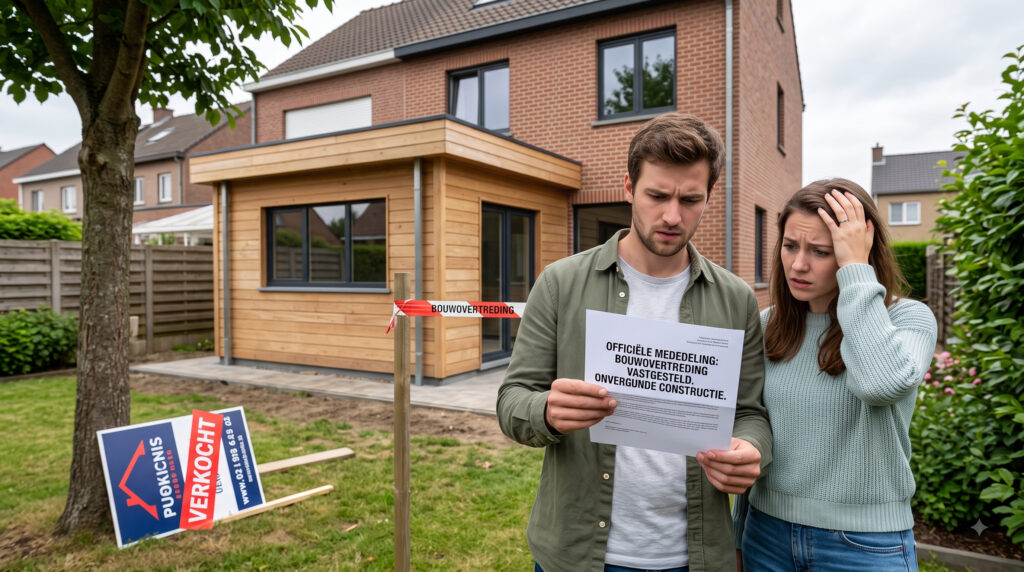
Some time after buying a home, you discover that an extension was built without a permit or, for example, that the building is larger than authorized. Aside from any application you might make to regularize the planning violation (infraction urbanistique), you can also consider taking action against the seller. The arguments available and what you can claim depend on your circumstances.
Planning violations in Belgium: hidden defect claims
To hold the seller liable, you could first argue that the property you bought has a hidden defect (vice caché). However, most sales agreements (conventions de vente) contain a clause stating that the seller provides no warranty against hidden defects. This type of clause is perfectly valid.
If your sales agreement contains such a clause, you can only hold the seller liable for hidden defects if they knew about the planning violation at the time of the sale. As the buyer, you must prove this. If the seller carried out the unauthorized construction themselves, that will generally be fairly easy to prove.
If, however, the seller bought the property from someone else who committed the planning violation, proving their knowledge may be harder. You also cannot wait too long to bring this type of claim after discovering the problem. A hidden defect claim must be brought within a short period.
Other possible arguments
You could also argue that the seller deceived you. To do so, you must be able to show that they used what are known as “fraudulent maneuvers” (manœuvres frauduleuses) to persuade you to buy the property. For example, they may have deliberately lied about permits when you asked about them as the buyer.
Another possible argument is mistake (erreur): you believed you were buying a property that fully complied with planning requirements. Bear in mind, though, that the seller could respond that you should have made the necessary inquiries yourself before buying, particularly with the municipality.
As the buyer, you might also argue that the seller owes you a warranty against dispossession (éviction), meaning protection against losing your rights to the property.
What can you claim?
Depending on the seriousness of the planning violation, the strength of your case and what you ultimately want to achieve, you could first seek annulment (annulation) or termination (résolution) of the sale. If that request is granted, you get your money back and must return the home to the seller. You can also claim damages for the loss you have suffered.
Another option is to keep the home and request a price reduction or damages. These could, for example, reflect the property’s loss in value due to the planning violation, the cost of demolishing what was built without a permit, the cost of regularization, and so on.
In all cases, it is advisable to consult a lawyer. They can explain the steps available in your particular situation and which claims would be best to pursue.
Can you hold other parties liable?
You do not necessarily have to limit your claim to the seller. You may also be able to seek damages from the real estate agent involved in the sale and/or the notary (notaire) before whom the notarial deed was signed. They are required to carry out certain checks and request certain information.
That does not mean, however, that the real estate agent and/or notary will automatically be liable whenever a planning violation exists. Discuss your chances of success with your lawyer before deciding to bring a claim against either of them.
 Open Immovlan