

The spectacular snowfall of the past few days has been magical, especially for children. For homeowners in Belgium, though, roof snow safety may be making it a little harder to sleep soundly.
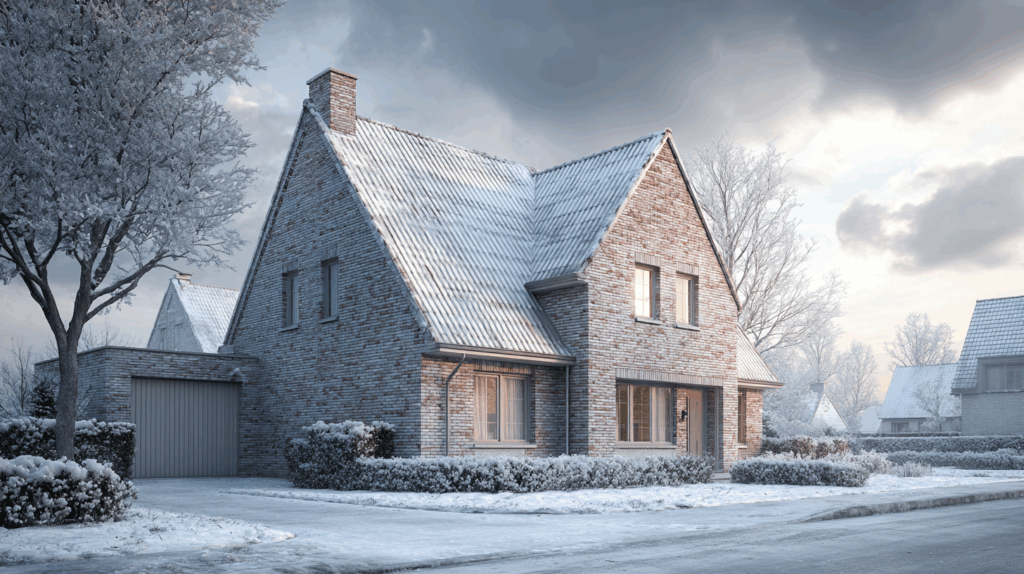
Snow may look like cotton from a distance, but once it piles up on your roof structure, it can start behaving more like lead. An unwanted indoor pool in the attic is nobody’s idea of winter fun. Here’s a look at what your home can actually withstand.
Contrary to what you might expect, the depth of the snow is not what matters most. Its character makes the difference. On average, a modern Belgian roof is designed to support a load of around 50 to 70 kg per square meter (or half that for roofs with a lightweight structure), which leaves some room for maneuver.
Roof snow safety: why density matters
The powder snow that skiers love weighs around 100 kg per cubic meter. At that density, 50 to 60 centimeters can accumulate without too much cause for concern. But this is Belgium, where rain rarely stays out of the picture for long. That lovely powder can quickly become waterlogged wet snow, with its weight shooting up to 300 or 400 kg per cubic meter.
To put that into perspective, ten centimeters of this icy slush weighs as much as fifty centimeters of fresh snow. If freezing rain joins in, the weight can become critical very quickly. Flat roofs, popular in contemporary buildings, are particularly exposed because gravity does not help them shed the snow.
Why sunroom roofs need special attention
A sunroom roof made of polycarbonate or double glazing does not have quite the same resilience as a slate roof. Polycarbonate resists impacts, including the children’s stray balls, but it can bend under an excessive load. Glass, unless it is laminated or specifically reinforced for snow loads, could develop a rather less picturesque pattern of cracks. That’s the theory, at least.
Good-quality Belgian sunrooms are generally designed to meet the same standards as homes, but they have a weak point: their frame sections. If snow builds up unevenly, forming drifts, pressure on one side can distort the structure. If the layer of wet snow exceeds 15 centimeters, using a telescopic broom to clear the frame sections is a sensible precaution.
Garden sheds and carports: lighter structures at risk
Many inexpensive kit models are not designed to carry the weight of an Ardennes winter. Their roofs, often little more than boards covered with bituminous roofing felt, can quickly sag. If yours houses the lawn mower and the whole family’s bikes, check the structure as soon as snow starts settling. A roof with a visible “belly” may be close to giving way.
A carport presents a less obvious danger. Often exposed to wind from all sides, it faces lateral pressure as well as vertical loads on what may be a lightweight structure. If your car costs more than the carport itself, you certainly don’t want it flattened beneath beams and snow. Manufacturers sometimes recommend clearing snow once it exceeds 10 cm, and warranty coverage may not apply if that limit is exceeded.
Warning signs to watch for
Some signs that your home is struggling under the weight of winter are subtle. If your interior doors suddenly start sticking or cracks appear in the plaster, the roof structure may be bending under the load.
Cracking noises are another warning you should not ignore. A house that starts “talking” more than usual deserves attention. It is also worth checking your beams for deflection, meaning how far they bend. If they look more like bows than straight supports, it is time to act.
That said, there is no need for alarm. Unless your roof structure is badly worn or carrying loads it was not designed for, such as tons of insulation without reinforcement, a few centimeters of snow are unlikely to put your home at risk. A thaw is rarely far away, either.
Should you clear snow from your roof?
Climbing onto an icy roof is generally a good way to end up in the emergency room. If you need to clear snow, work from the ground with a telescopic roof rake or, better still, call in professionals.
There is no need to remove every last bit. Leaving a few centimeters of snow will do no harm and helps avoid damage to your slates or roof tiles. The aim is simply to ease the load on the structure. Please do not use salt on your roof: it can harm your zinc gutters and the plants below. Keeping drainage outlets well maintained before winter remains the best prevention, helping your roof drain properly and withstand winter conditions.
What a typical Belgian winter means for your roof
Most Belgian homes built to the applicable NBN standards have nothing to fear from a typical winter. Engineers generally allow comfortable safety margins. Climate change and its sometimes extreme weather events do, however, call for a little vigilance. Watch for snow buildup and listen for unusual sounds from your home while staying warm indoors, with the snow safely on the other side of the roof.
 Open Immovlan