

Some call them “Japanese toilets”, others “wash toilets”. But “shower toilet” is the name now catching on in Belgium. No, it is not a shower you can use as a toilet, but a specific type of toilet gaining ground here. Here are the shower toilet pros and cons to consider.
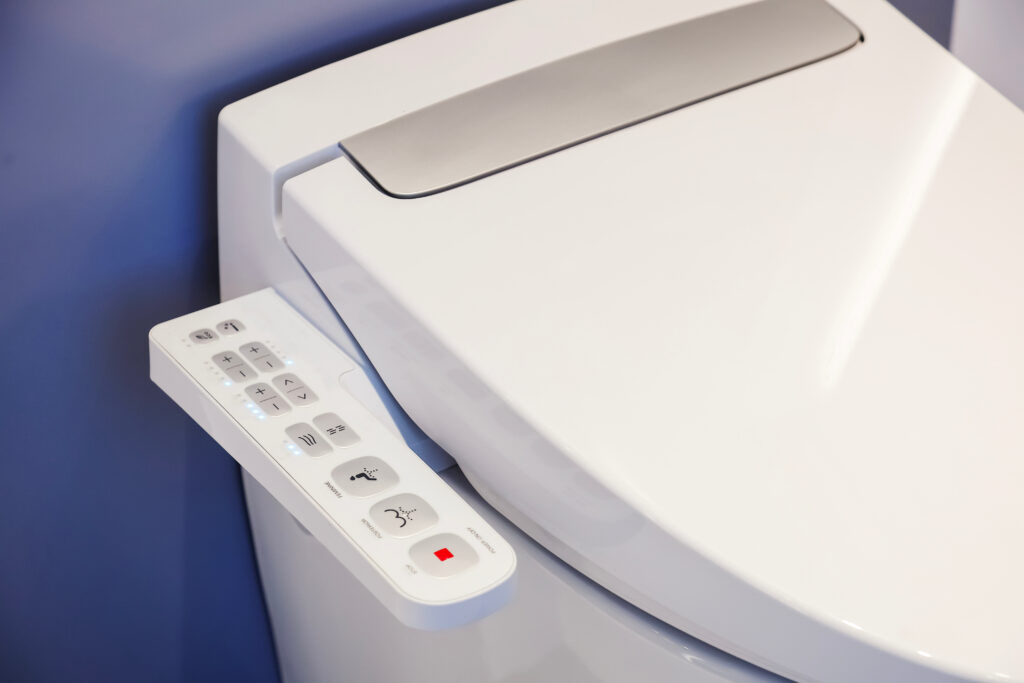
The world is changing, and so are our bathroom habits. Today, the bidet has disappeared entirely from building plans. The need to feel clean, though, is still very much with us. Enter the shower toilet, a hybrid fixture that is changing our routines.
The Japanese toilet is Swiss!
Long seen as an eccentric luxury reserved for Tokyo’s high-end hotels, the shower toilet, or “Japanese toilet”, is steadily making its way into Belgian homes. Despite a persistent belief, it did not originate in Japan. A Swiss inventor, Hans Maurer, developed the first model in 1957. It was only in the 1970s and 1980s that the Japanese turned this medical concept into an everyday fixture. The principle is remarkably simple: a washing nozzle is built directly into the ceramic toilet bowl. Once you have finished your business, pressing a button releases a jet of warm water that cleans with surgical precision.
Shower toilet pros and cons: the environmental impact
Toilet paper’s hygiene credentials deserve a closer look. If you had mud on your wood floor, rubbing it with a dry towel would hardly make it clean. You would reach for a mop and water. Producing a single roll of toilet paper also requires around 168 liters of water and contributes to global deforestation. By contrast, a shower toilet uses barely one liter of water per wash cycle. That makes it a choice for the planet as well as your comfort.
For anyone still weighing their options, there are now three main product categories.
- The complete shower toilet offers the most refined design, with all the technology hidden within the ceramic, as on Geberit’s AquaClean or Grohe’s Sensia Arena models.
- A bidet toilet seat is a practical compromise that fits onto your existing toilet bowl, making it ideal for renters.
- The handheld bidet sprayer, very common elsewhere but more basic, remains the cheapest option for washing with water. Cold water in the middle of winter can sometimes make it a rather abrupt wake-up call, though.
How much does a shower toilet cost?
Upgrading to a smart throne takes a certain budget. For an entry-level but complete model, expect to pay around €700 to €1,000, excluding installation. If you want the “Rolls-Royce” version with a heated seat, odor extraction and warm-air drying, prices can reach €5,000 or more.
Installation is not straightforward
The technical installation is no small job. A shower toilet needs water, but also electricity. That is where Belgium’s General Regulations on Electrical Installations (Règlement Général sur les Installations Électriques, RGIE) come into play. The circuit must be protected by a 30 mA residual-current device. Forget improvised DIY: water and electricity do not mix, especially when you are in such a vulnerable position.
Belgium is also known for its hard water. Limescale is the worst enemy of precision nozzles. To stop your water jet from turning into an unruly fountain, monthly cleaning with white vinegar or the installation of an anti-limescale filter is strongly recommended.
Hygiene and comfort
There is also the health aspect. For people with hemorrhoids or sensitive skin, repeated rubbing with toilet paper can be an ordeal. Water cleans gently, without irritating the skin with the bleaching chemicals found in some toilet paper. It offers a considerable gain in dignity for older people, as well as added comfort for women.
Can you use rainwater?
For flushing, absolutely. A single flush uses between 7 and 12 liters of drinking water, with flushing accounting for around 30% of a household’s total water consumption. Rainwater’s low mineral content also makes it gentler on your pipes. For intimate washing, however, it is strictly prohibited. Leading manufacturers such as Geberit explicitly state in their technical specifications that you must not use rainwater for the washing jet.
Unlike mains water, which is subject to dozens of water-quality criteria, rainwater is not drinkable and undergoes no checks. As it sits in a tank or runs off a roof, it can pick up atmospheric pollutants, harmful bacteria or mold. Using it for personal hygiene poses a risk of infection or Legionnaires’ disease, even if you have added filters. When installing a shower toilet, you should therefore ideally plan for two separate water supplies: rainwater for flushing and mains water for the cleaning jet.
 Open Immovlan