

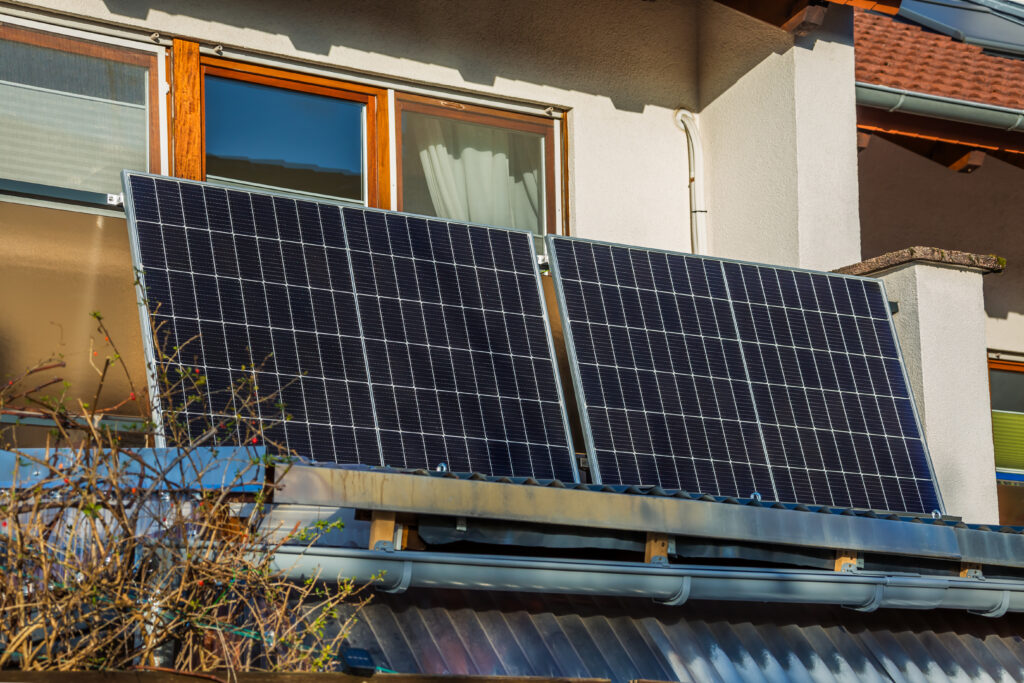
Small plug & play balcony solar panels in Belgium are no longer a novelty. In Germany, registered installations passed the million mark in June 2025, following a major regulatory boost that also strengthened tenants’ and co-owners’ rights to install them. Here is where Belgium stands.
The wider European context is encouraging solar power too. SolarPower Europe estimates that existing solar installations in the EU avoided more than €110 million in gas imports per day in the first half of March 2026, and €3.77 billion over the full month.
Why these small panels are so popular
Their appeal is simplicity. One or two small panels connect to an approved microinverter and a power outlet, with the electricity first covering the home’s ongoing background consumption. On paper, this is ideal for an apartment, balcony or terrace: you can start consuming the electricity you generate without building work, a huge roof or a five-figure budget. Bear in mind that only devices approved by Synergrid can legally be used in Belgium.
The rules for balcony solar panels in Belgium
Plug & play solar kits have been allowed in Belgium since April 17, 2025. In Wallonia, you must declare them to the grid operator. In Brussels, you need a smart meter and must declare the kit to Sibelga. These kits do not qualify for green certificates (certificats verts). In Flanders, registration is not mandatory if you have a digital meter and an inverter rated below 800 W. It is mandatory if you have an analog meter or an inverter rated at 800 W or above.
How well a kit fits your household
On paper, a kit can be worthwhile. A 400 W kit now costs just under €500, but according to Test Achats, you should not expect more than 380 kWh per year in Belgium. That could mean around €115 in annual savings if you use the electricity as it is generated. In practice, a household that is home during the day can genuinely benefit, provided the balcony gets good sun exposure and the home has a small, continuous background electricity demand. Do not expect to become completely self-sufficient, though.
What can dampen the appeal
The main pitfall is not Belgium’s sunshine, which often gets the blame, but your electrical installation and housing situation. The Federal Public Service Economy (SPF Économie) recommends a fixed power outlet, with no power strip or extension cord, and advises checking that the circuit and electrical installation are suitable. In Brussels, a kit visible from the street may also require a planning permit (permis d’urbanisme). If your property is part of a co-ownership (copropriété), or you rent your home, you also need to check the internal rules and obtain the necessary permissions.
Who benefits most
These kits are worth considering in Belgium, especially for tenants, apartment dwellers and households looking for a first step into solar power without major work. For others, a conventional installation on a roof with good sun exposure remains more cost-effective.
 Open Immovlan