

Water is pooling in the bathtub, the sink won’t drain or the toilet is overflowing. You need to act, but who pays? Blocked drain responsibility in Belgium depends on where the blockage is and what caused it. Our lawyer explains when the bill falls to the owner, the tenant or the co-ownership (copropriété).
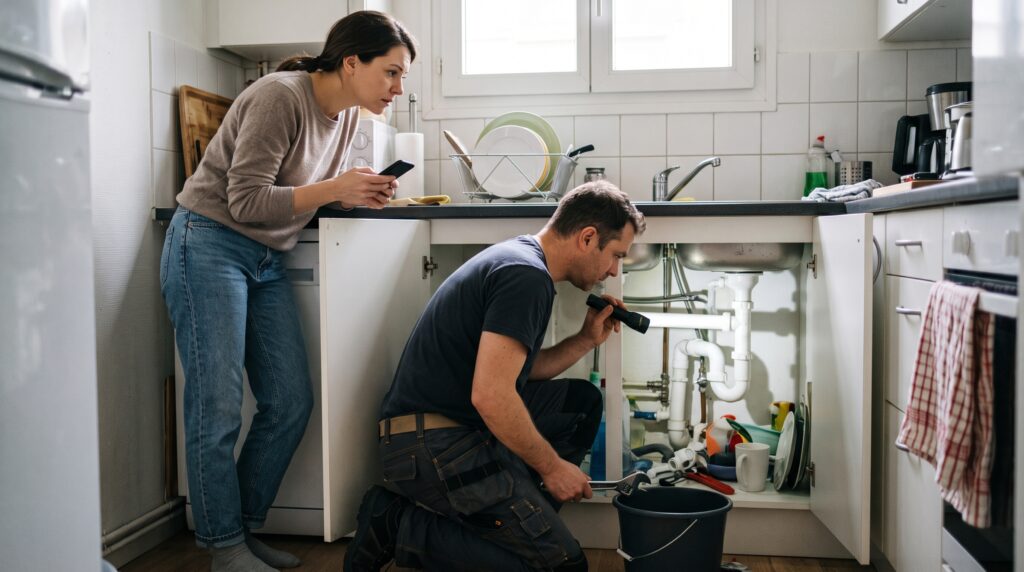
Blocked drain responsibility in Belgium: private or shared?
First, establish which pipe contains the blockage. Is it private, or does it form part of the building’s shared plumbing? If it is a private pipe, the apartment owner must arrange and pay for it to be cleared, subject to the division of responsibility between owner and tenant explained below. If the blockage affects a shared pipe, the association of co-owners (association des copropriétaires) is responsible for arranging the work. This association is usually known by its initials, ACP.
To find out which category the pipe belongs to, check the building’s co-ownership rules (règlement de copropriété). They specify what is private and what forms part of the common areas.
Misuse can change who pays
A blockage in a shared pipe does not necessarily mean the co-ownership will ultimately bear the cost. The ACP can sometimes recover the costs from the owner or tenant responsible. However, it must be able to prove that the person caused the problem.
This may apply when an occupant puts unsuitable products or waste, such as wet wipes, down the drains and these cause a blockage. An occupant’s responsibility cannot simply be assumed: it must be proven. As you can imagine, that is not always easy with shared pipes.
Who pays in a rented apartment?
The tenant must make sure the drains do not become blocked. If a blockage occurs because they have failed to meet this obligation, they must pay to have it cleared. The plumber usually determines the cause of the problem and, therefore, who is responsible.
However, if the problem results from wear and tear, a pipe that has sagged or a construction defect, the owner must resolve it. The fact that a tenant occupies the apartment is not enough to make them liable for the bill: the cause of the blockage matters too.
Contact the building manager (syndic) before calling a company
If you are unsure whether the problem is in a private or shared pipe, contact the building manager before hiring a drain-clearing company yourself.
If you arrange the work directly, the ACP may refuse to reimburse your costs. You could then have to pay out of your own pocket, even if the blockage turns out to have been in a shared pipe.
A quick call to the building manager beforehand could save you a second unpleasant surprise when the bill arrives!
 Open Immovlan