

In 1980s Berlin, the LiMa Wohnhof cohousing complex promised village-style neighborhood life, with residents finishing their own homes. A 29-minute documentary explores what remains of that dream…
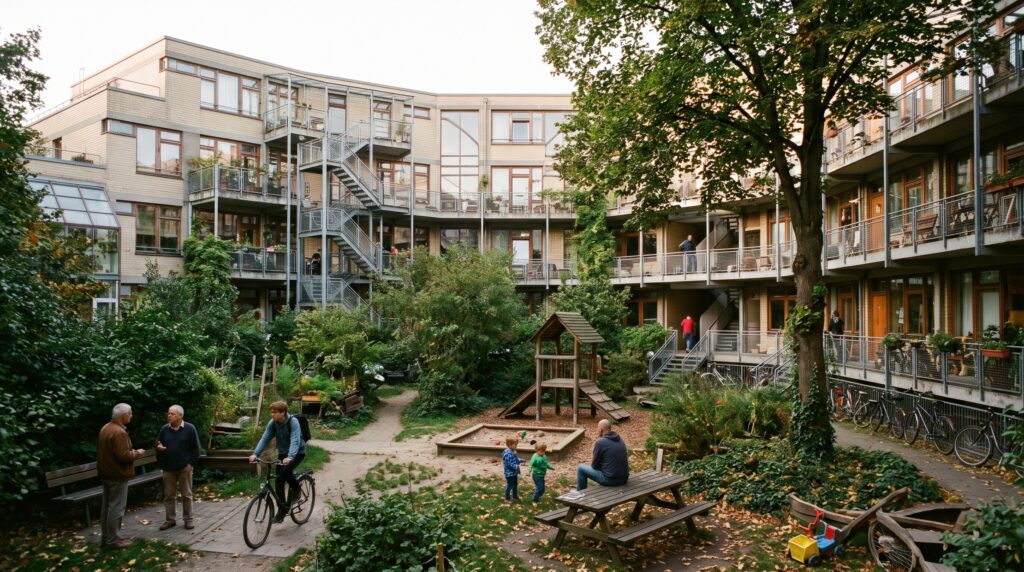
A building handed over for residents to finish
The story begins in the mid-1980s in Kreuzberg, a working-class neighborhood of Berlin. The city was hosting IBA 1984/87, an international architecture exhibition whose exhibits were not models but real, occupied buildings. Dutch architect Herman Hertzberger designed the LiMa Wohnhof for the exhibition, working with Berlin architects Inken and Hinrich Baller. The plan: 48 social housing units around a shared courtyard.
The empty-shelf principle
Hertzberger is a leading figure in structuralism. Behind that rather formal term lies a simple idea: the architect provides the framework, like an empty shelf, and residents arrange their lives within it as they choose. Instead of a move-in-ready apartment, future occupants received a shell to finish themselves. Doing some of the work reduced their housing costs. The project became a testing ground for collective self-build (homes built partly by their occupants) and shared decision-making.
Cohousing designed to bring neighbors together
The building steps down in tiers to blend with its neighbors and surrounds a shared garden with a playground. Wide balconies and numerous stairwells connect each home to this communal outdoor space. Getting home without bumping into anyone is all but impossible, and that is deliberate.
40 years later, residents have their say
The documentary Such a Thing Like Happiness, by Magda Gvelesiani and Sarah Silbernagel, had its world premiere in October 2026 at the Architecture Film Festival Rotterdam. It gives the floor to the people who live there. No marketing talk, just lived experience.
Solidarity, but friction too
The film shows the bonds between neighbors, but also the conflicts and tensions that community living inevitably brings. Some shared facilities are used less than they once were. Residents nevertheless remain deeply attached to their building: the building and its gardens have had protected monument status since 2020, partly thanks to their campaigning.
An old project amid today’s housing crisis
The filmmakers also place the experiment in the context of the current housing crisis: rents that residents struggle to keep up with, people pushed out of their neighborhoods, and housing passing into private hands…
What can we take from this in Belgium?
Direct comparisons need care. The film’s presentation provides no figures on running costs or residents’ satisfaction, and Berlin’s social housing context in the 1980s is not today’s Belgian property market. Still, the experience offers something worth considering for cohousing (habitat groupé) projects, intergenerational residences or co-ownership (copropriété) buildings whose residents would like a shared room. Many groups start by buying a large house or an old farmhouse together that none of them could have afforded alone. Shared spaces need managing, though. Before committing to a purchase through a notary, renting a home in a complex with a communal garden is a good way to try out this kind of life with neighbors.
 Open Immovlan