

You rent a house or apartment, and your landlord wants to put a sign in the garden or behind a window. Knowing your tenant rights in Belgium can help you understand what you have to accept while you still live there. Your landlord can advertise the property for sale or rent, but must also take your day-to-day life into account.
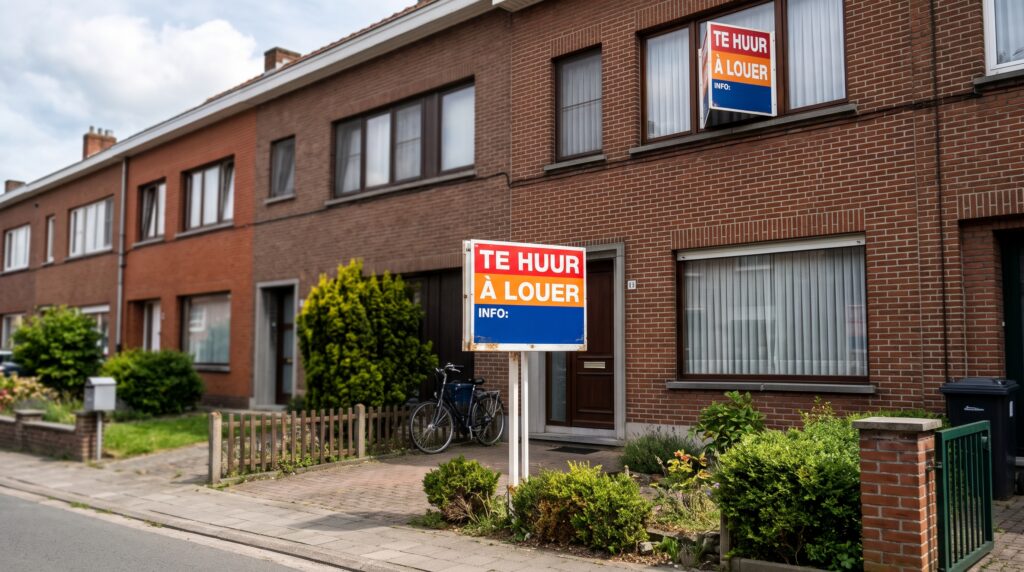
This situation can arise when your lease is nearing its end. You may, for example, have given notice, and your landlord is already looking for your replacement. To attract prospective tenants, they want to put a sign directly on the property. To find out whether they are legally allowed to do so, start with your lease.
Tenant rights in Belgium: start with your lease
First, check what your rental agreement says. It may contain a clause about advertising the property for rent as the lease approaches its end, or putting it up for sale.
This clause may specifically allow the landlord to advertise on the property itself. A sign behind a window or in the garden may therefore be among the options covered by the agreement you originally signed.
In principle, this type of clause is valid. You cannot assume that all advertising is prohibited simply because you are still the tenant. Read the specific terms of your lease again to check what you agreed with your landlord. That permission does not, however, give them a free hand.
What if your lease says nothing about signs?
If your lease says nothing about advertising signs, that does not mean your landlord has to wait until you leave before advertising the property for sale or rent.
Even without a specific clause, they are generally entitled to advertise their property. They can therefore arrange to put a “for rent” or “for sale” sign on the home you occupy or in its garden.
The absence of a written clause is not, on its own, enough to justify refusing all signs. What matters then is how the advertising is installed: its position and size can make all the difference to you.
Signs are allowed, but there are limits
Your landlord must choose an option that causes you as little inconvenience as possible. You still live in the property, and the advertising must take that into account, even if a move or sale is being planned.
For example, without your agreement, they cannot cover an entire window with an advertising sign. A small sign in the corner of a window and a large one covering the whole opening clearly have different effects on the light and your view.
The same principle applies in the garden: the advertising must not cause you excessive inconvenience. The right to advertise a sale or rental does not justify an oversized installation that interferes with your use of the property.
The most practical approach is to discuss the sign’s size and position together. The aim is to make the property visible to prospective buyers or tenants while allowing you to continue living there comfortably.
 Open Immovlan