

Among New York’s demolished skyscrapers, the Singer Building has a truly tragic story: a Beaux-Arts giant and a Broadway star that ended up razed to the ground.
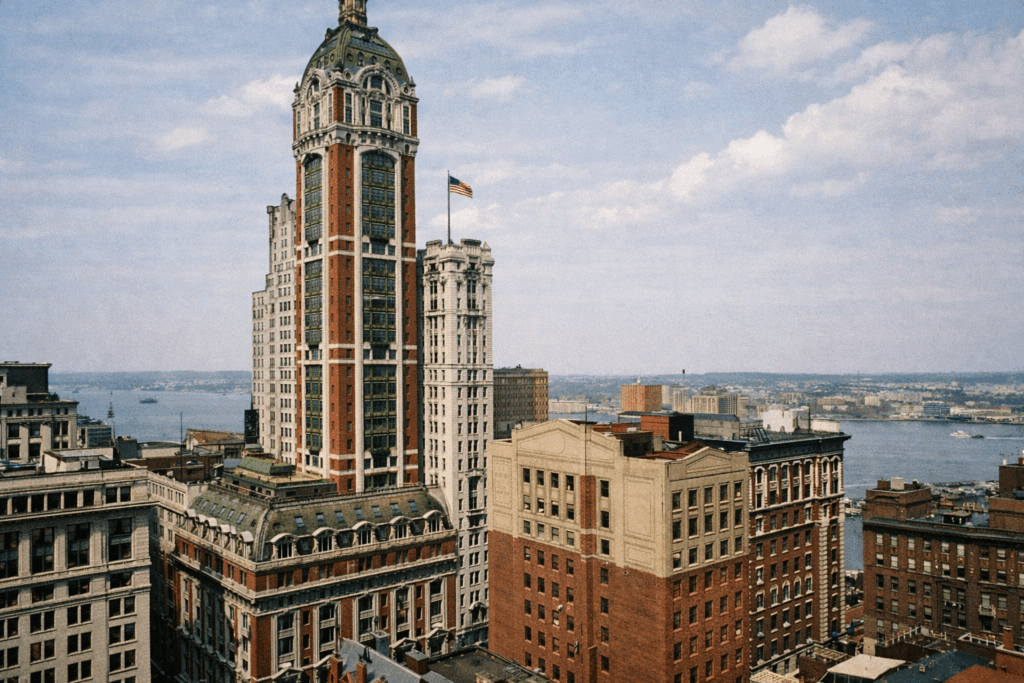
At the corner of Broadway and Liberty Street, in the heart of the Financial District, a distinctive silhouette once stood out from afar, especially at night. It was a slender tower crowned with a dome and a lantern, as though New York had given itself a lighthouse.
The Singer Building (also known as the Singer Tower) began with a very practical commission: to house the headquarters of the Singer Manufacturing Company, the sewing machine brand. But in New York at the time, housing a business could also mean leaving a permanent mark on the city. Frederick G. Bourne led the project, with architect Ernest Flagg designing a building that enthusiastically embraced Beaux-Arts and French Second Empire styles. Quite a statement in New York!
A building that took shape in stages
The building’s story unfolded in phases. First came the base: an initial 10-story building constructed in 1897 to 1898. Next door, the 14-story Bourne Building annex was completed in 1899. Then, in the early 20th century, came the idea that changed everything: connect and expand the buildings, and, above all, dare to add a tower.
Between 1906 and 1908, the complex became a four-part development, including an enlarged base and a tower rising another 27 stories. The final total reached 41 stories, a record at the time. The materials matched that ambition: brick, stone and an almost outrageous quantity of terracotta, not to mention decorative copper. Understated it was not, but it was unmistakably of its era.
The world’s tallest building, for a brief moment
On completion, the tower had a roof height of approximately 187 m, with its tip reaching 205 m. That made it the tallest building in the world. Its reign was short: the Metropolitan Life Insurance Company Tower overtook it the very next year.
Inside: marble, bronze and a flair for the theatrical
The interior was just as flamboyant as the exterior, with the lobby as its showpiece. Marble, including Pavonazzo, shared the space with bronze, medallions, plaster domes and gilded details. The almost theatrical setting gave occupants the sense that they worked somewhere very important.
There was modern technology, too: 16 elevators, including express elevators that moved at impressive speeds for the time. In June 1908, the building offered an observation deck with views stretching for miles across New York. Access was eventually closed following tragedies.
New York’s demolished skyscrapers: the loss of an icon
For all its status as an icon, the Singer Building could not escape Manhattan’s brutal equation: the price per square meter leaves no room for sentiment. From the 1960s onward, real estate pressure soared. The building was eventually sold and earmarked for replacement by a larger, more profitable project, one considered more “efficient.” The result: it was demolished between 1967 and 1969.
It made way for “One Liberty Plaza,” a tower completed in 1973, with much larger floor plates but a far more ordinary silhouette. At the time, the Singer also became the tallest building ever demolished by its owners, a sad record.
 Open Immovlan