

Snow clearing rules in Belgium determine who must clear and secure the sidewalk alongside an apartment building when snow or ice forms. Here is how to find out which co-owner or resident is responsible, and what risks you face if the sidewalk remains slippery or impassable.
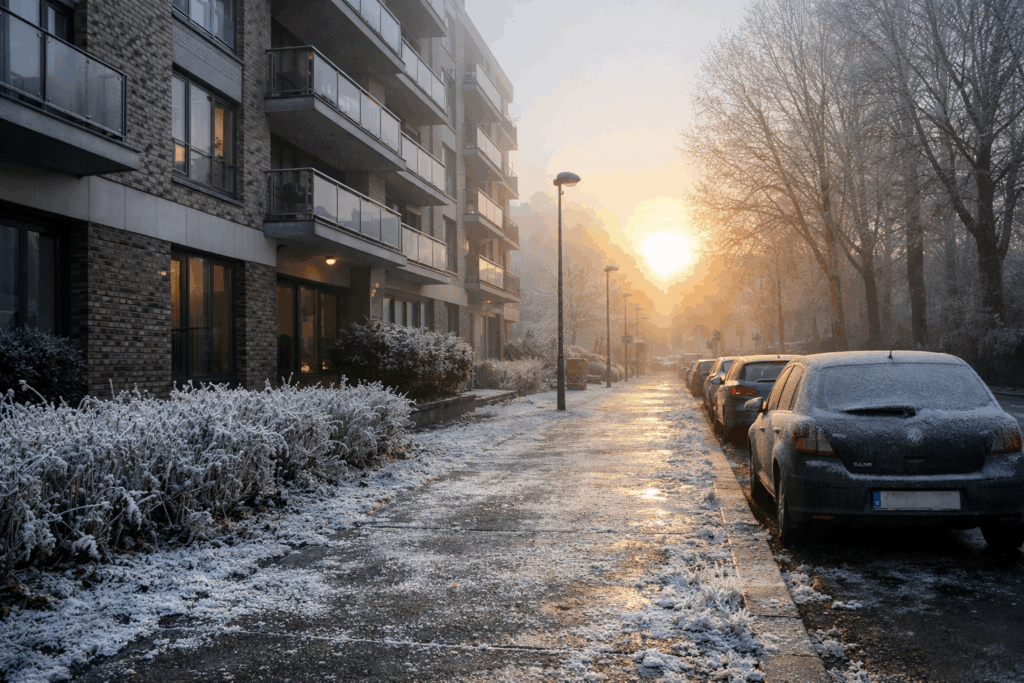
Snow clearing rules in Belgium: local police regulations
In most municipalities, police regulations (règlements de police) place this responsibility on residents. When ice forms, residents are generally required to clear the sidewalk in front of their home and may also have to make it safe, for example by spreading salt. After snowfall, many municipal regulations require residents to clear a safe passage, often with a minimum width of around one meter, so pedestrians can pass safely.
Who is responsible outside an apartment building?
To find out who must clear snow from the sidewalk outside an apartment building, start by checking the municipal police regulations. However, most of these regulations do not contain specific provisions covering apartment buildings.
Where specific rules do exist, they often assign the duty first to the person responsible for the building’s daily upkeep. This might be a concierge, caretaker or maintenance worker.
If the building has no concierge, caretaker or technician, responsibility frequently falls to the occupants of ground-floor apartments, with priority given to those whose homes face the street directly. If no one lives on the ground floor, the duty generally passes to residents on the floor immediately above it, and then upward, floor by floor, until someone is designated as responsible under the municipal rules.
When the municipal rules make no provision
If the municipal police regulations say nothing about this, the building’s co-ownership rules (règlement de copropriété) or internal rules (règlement d’ordre intérieur) may specify who is responsible for clearing snow and ice from the sidewalk. These internal documents can divide the duties among co-owners or assign the task to a specific person.
If neither set of rules provides a solution, you are strongly advised to put the issue on the agenda of the general meeting of co-owners (assemblée générale des copropriétaires). The meeting can then formally appoint someone responsible or agree on practical arrangements to meet the legal obligations and avoid disputes or penalties.
Fines and liability
If the sidewalk outside your building remains impassable, you risk a municipal administrative fine (amende administrative communale). The amount can vary by municipality, but a fine is a real possibility if an inspection takes place.
You may also face civil liability if someone falls on the sidewalk outside the building because it was not properly made safe. You could then be held responsible for the harm the injured person suffers, including medical expenses, temporary inability to work or other losses.
 Open Immovlan