

Interest in natural insulation keeps growing, and for good reason. Rising energy costs, sustainable renovation requirements and the desire to build healthier homes are encouraging many homeowners to consider wood fiber, hemp, cellulose, cork, straw or sheep’s wool. For homeowners in Belgium, understanding natural insulation pros and cons can help establish whether these materials are a good choice.
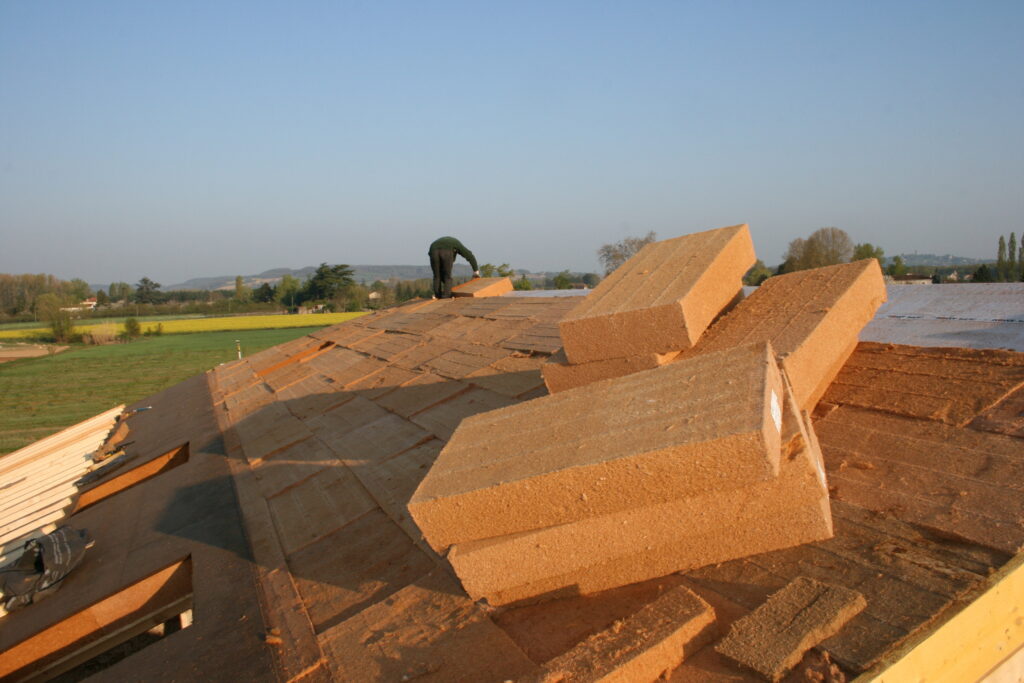
The technical term often used is bio-based materials, meaning materials derived from plant or animal biomass. Their main advantage on paper is clear: they provide insulation while reducing a building’s environmental impact, particularly through the use of renewable resources and carbon storage over the building’s lifetime.
Natural insulation pros and cons: thermal performance
In practice, these materials are not just “green” for appearances. They can also perform very well. Buildwise reports that, in on-site tests, some bio-based insulation materials achieved thermal performance equivalent to that of mineral wool, with results close to theoretical values. For sound insulation, flexible materials with an open structure, such as cellulose, plant fiber or sheep’s wool, also perform comparably to conventional options. Choosing bio-based insulation does not mean sacrificing effectiveness.
Summer comfort: a benefit with limits
Summer comfort is another argument often made for bio-based insulation, and there is some truth to it. These materials are often denser and can slow the transfer of heat. ADEME cites rice straw, for example, as a promising option for combining winter and summer comfort. But expectations need to be realistic: Buildwise points out that, across a whole building, the type of insulation often has less influence than solar shading, nighttime ventilation, airtightness or the type of interior finishes. Natural insulation can help, but it cannot single-handedly fix overheating caused by large windows with inadequate shading.
Higher costs and other limitations
There are drawbacks, and they are far from minor. The first is the purchase price, which is often higher than for conventional insulation, even as the market develops and volumes gradually increase. ADEME notes that in 2025, bio-based materials already account for 11% of insulation used in the sector in France, a sign that the industry is becoming established. In Wallonia, this extra cost can be partly offset by more favorable grants (primes) for certain work using bio-based insulation, with listed amounts of €26/m² for roofs, €12/m² for walls and €8/m² for floors.
A few misconceptions also need clearing up. Bio-based does not automatically mean local: a material can come from plants or animals yet originate in another region or country. A short supply chain depends mainly on the industry, the manufacturer and the production location. What is more, most bio-based insulation currently sold is not compostable, notably because it often contains synthetic binders or antifungal and fire-retardant additives. Look at the actual product, not just the marketing label.
Proper installation makes the difference
Ultimately, the most important factor is installation. A good natural insulation material can become a poor choice if installed badly. Official sources stress that you should never insulate a wall or other building element showing signs of damp. The building must be in sound condition, materials must be stored dry, and rising damp must be prevented. Installation also requires careful attention to airtightness, provision for effective ventilation and compliance with fire safety rules. It is also better to choose products with recognized certification, such as ACERMI, to verify their stated performance. Natural insulation can be a good choice for a well-planned, sustainable project carried out properly. But if your only aim is to pay as little as possible per square meter, it will not always be the most cost-effective option in the short term.
 Open Immovlan