

If you’re considering recording condo meetings in Belgium to protect your interests, you’ll want to know where you stand legally. Here’s what to know before making an audio recording at the next general meeting, including whether you can use it in court.
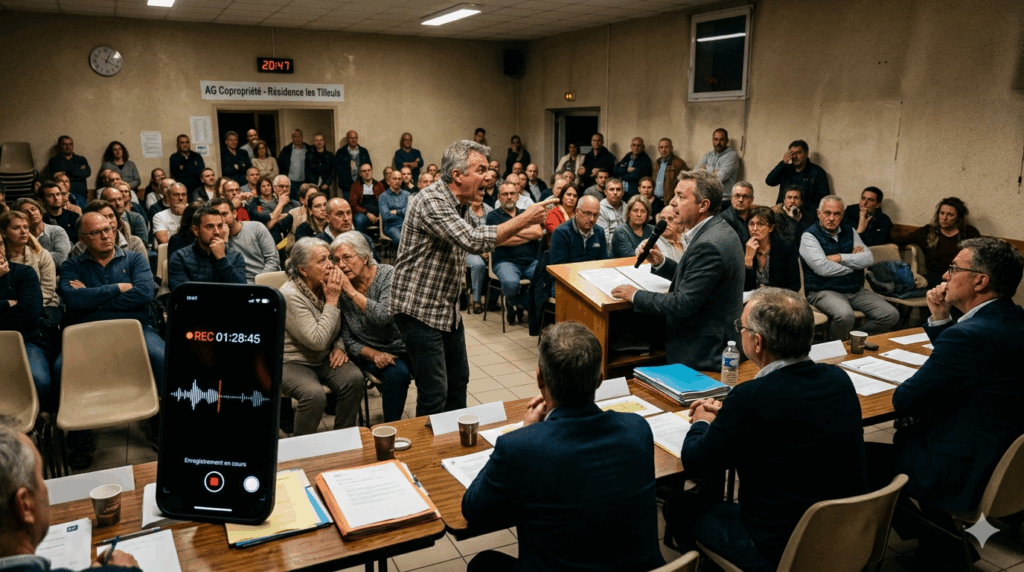
Recording condo meetings in Belgium is not prohibited
The law does not prohibit you from making an audio recording of what is said during the general meeting of co-owners (assemblée générale des copropriétaires). You can therefore record the discussions without asking for the consent of the other co-owners attending. You do not need permission from the property manager (syndic) either. You can even record discreetly, meaning without explicitly announcing beforehand that you will be recording the discussions. The fact that some participants would prefer not to be recorded is not, in itself, enough to make recording prohibited.
Using the recording as evidence
As a general rule, your recording can also serve as evidence if, for example, you bring legal proceedings against the property manager or challenge decisions made by the general meeting. In that case, it is advisable not to submit only a USB drive or an audio file: it is better to include a written transcript of the recording. In the transcript, you can clearly identify the passages that matter to the case to help the court understand the context.
How might the other party challenge your recording?
There is no guarantee, however, that your recording will play a decisive role in any proceedings, or that the court will take it into account at all. The other party might argue, for example, that the recording is not authentic and that you have altered or manipulated it, perhaps using artificial intelligence. Their aim would be to cast doubt on the reliability of the evidence you submit. Even if you are convinced that it is accurate, its value as evidence may still be challenged.
The other party could also argue that you have presented only parts of the recording rather than the entire meeting, and that the full recording gives a very different picture of the situation. An isolated extract may indeed be interpreted differently when put back into context, especially if the discussions were heated or confused.
A co-owner or the property manager could also argue that your audio recording infringed on their expectation of privacy. The chances of such an argument being accepted remain very uncertain, however. This is particularly because the general meeting is specifically a setting where co-owners discuss matters relating to co-ownership (copropriété), and where everyone knows that what they say may have consequences.
 Open Immovlan