

Buying property during divorce in Belgium is possible, but you need to take a few precautions before committing to a new home to avoid unpleasant surprises.
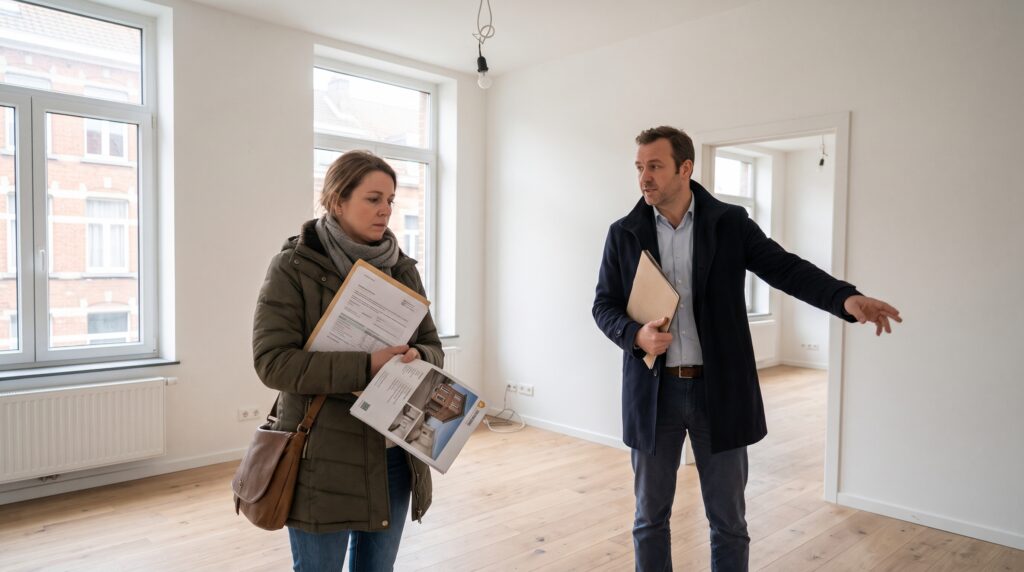
When a couple separates, housing quickly becomes a concern. Rather than paying rent for months, some people prefer to invest straight away in a new house or apartment. Renting can feel like “throwing money away,” so the reasoning makes sense on paper. But buying a property during divorce is not always as straightforward as it seems. Much depends on your marital property regime (régime matrimonial) and how far the divorce proceedings have progressed.
Buying property during divorce in Belgium: can you buy alone?
If you are still legally married, the first thing to check is your marital property regime. It largely determines what you can and cannot do.
If you are married under a separation of property regime (séparation de biens), you can generally buy a house or apartment on your own. Each spouse has their own assets and can make purchases in their own name, even while divorce proceedings are underway.
However, if you are married under the statutory regime (régime légal), which generally applies when there is no marriage contract (contrat de mariage), things become more complicated. This regime provides for joint assets alongside each spouse’s separate assets. If you want to buy a home before the divorce is final, your spouse may need to be involved in the purchase and give their consent.
There are exceptions, notably when you finance the purchase with funds that belong to you personally. However, you must be able to prove where those funds came from and meet the legal conditions. You therefore need to consult a notary (notaire) before signing anything.
Can you buy after divorce if your assets have not yet been divided?
Another fairly common situation is that the divorce is final, but the financial matters have not yet been settled. The liquidation and division of matrimonial assets (liquidation-partage du régime matrimonial), meaning the process of settling accounts and dividing assets between former spouses, can sometimes take time.
In this case, the rules are simpler: you can buy a new property on your own, without your former spouse having to take part in the purchase. Legally, you are free to proceed. That does not necessarily mean the purchase will be easy to finance, though.
Avoid putting yourself under financial pressure
This is probably the main pitfall. Even if you are allowed to buy, you still need to have the necessary funds.
Until the division of assets is complete, a substantial part of your wealth may remain tied up. For example, if you are counting on the proceeds from selling your former family home to finance your next one, you may have to wait.
Borrowing from a bank is not necessarily any simpler. An outstanding mortgage on your former home can make it harder to obtain a new loan, especially if your ability to repay is already limited.
There is another, less obvious but equally significant risk: committing to a new purchase too quickly could put you under financial pressure. You might even have to accept a less favorable agreement on dividing your assets simply to release the funds you need.
Buying during divorce is sometimes possible, but it is best not to rush. Before committing, take the time to work through your finances and review your situation with your notary to avoid adding further complications.
 Open Immovlan